
The Four Varnas – The Social Manifestation of Bhagavan’s Six Divine Qualities


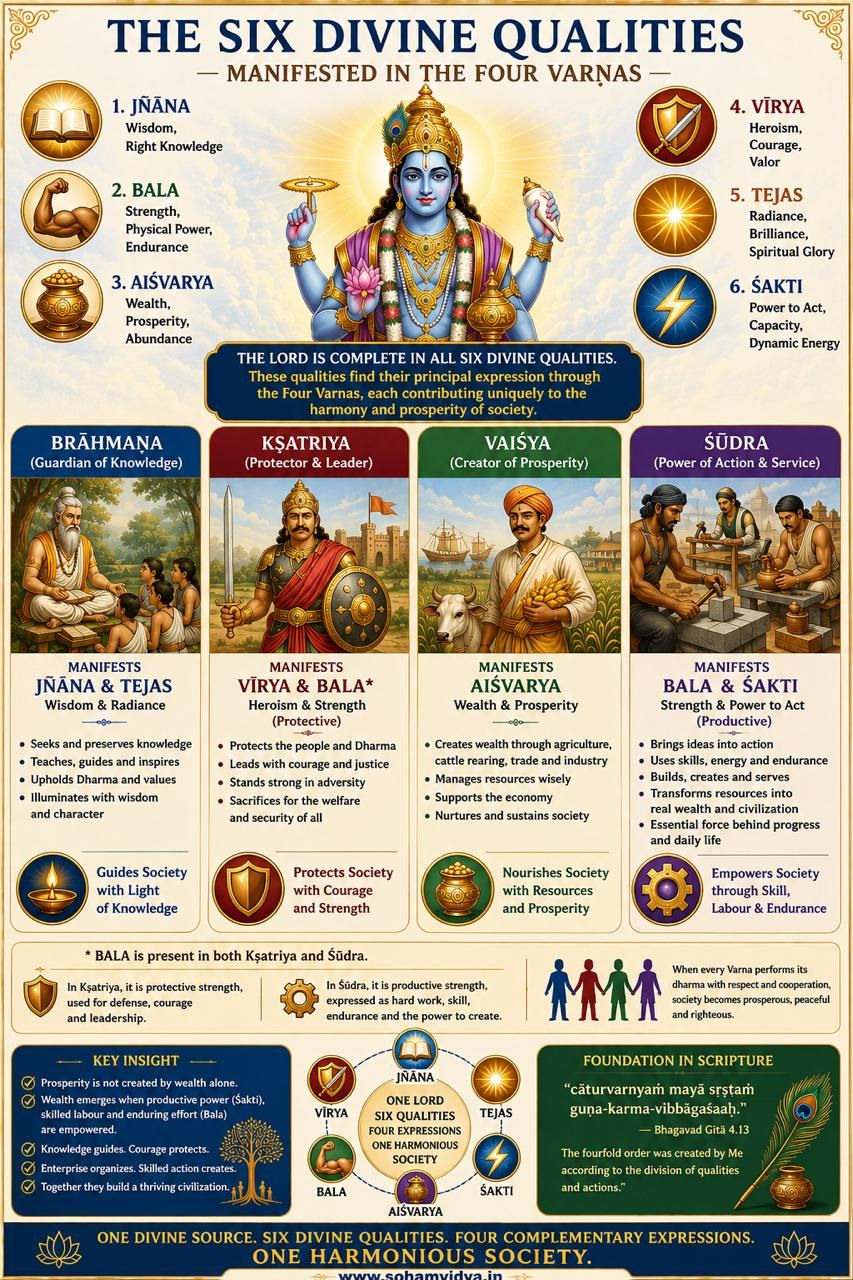
The scriptures reveal a profound truth about the Bhagavan- The Supreme Lord. The Lord is Ṣaḍguṇa Sampūrṇa—perfect and complete in the six divine qualities of Jñāna (Knowledge), Bala (Strength), Aiśvarya (Prosperity), Vīrya (Heroism), Tejas (Radiance), and Śakti (Power). These six qualities exist not as separate attributes but in perfect harmony within the one Supreme Reality.
Lord Śrī Kṛṣṇa further declares in the Bhagavad Gītā:
"Cāturvarṇyaṁ mayā sṛṣṭaṁ guṇa-karma-vibhāgaśaḥ."
(Bhagavad Gītā 4.13)
"The fourfold order was created by Me according to the divisions of qualities and actions."
This teaches that the varṇa system is fundamentally based on qualities (guṇa) and actions (karma) rather than birth.
Viewed together, these teachings suggest an illuminating perspective: the Lord's six divine qualities, though complete and inseparable within Him, find their principal social expression through the four varṇas, enabling society to function as an integrated whole.
The Kṣatriya principally manifests Vīrya and protective Bala. Through courage, leadership, sacrifice, and the protection of Dharma and society, the Kṣatriya provides security without which knowledge and prosperity cannot flourish.
The Vaiśya principally manifests Aiśvarya. Through agriculture, cattle rearing, trade, industry, and enterprise, the Vaiśya creates and manages resources that nourish and sustain society.
The Brāhmaṇa principally manifests Jñāna and Tejas. By preserving, teaching, and living knowledge, upholding Dharma, and providing moral and spiritual guidance, the Brāhmaṇa gives direction to society.
The Śūdra principally manifests Śakti together with productive Bala. Skill, craftsmanship, perseverance, disciplined labour, and the ability to transform ideas into reality are the hallmarks of this expression. The knowledge, leadership, and resources of society become tangible only through productive effort.
An important distinction must be made regarding Bala (Strength). In the Kṣatriya it appears as protective strength—the power to defend and lead. In the Śūdra it appears as productive strength—the endurance, skill, and sustained effort that transform resources into prosperity and civilization.
From this perspective, prosperity is not created by wealth alone.
Knowledge provides direction.
Courage offers protection.
Prosperity organizes resources.
Productive strength transforms those resources into civilization.
When these complementary functions work together, society becomes stable, prosperous, and Dharmic.
The principle of varṇa is reflected throughout human society. Every successful organization—whether in commerce, healthcare, voluntary service, national defense, or government—depends on people performing different but complementary roles. When each role is respected and valued, rather than considered superior or inferior, society becomes stable, resilient, and capable of sustained progress.

The four varṇas should therefore never be viewed through the lens of superiority or inferiority. Rather, they are complementary manifestations of the Lord's divine qualities. Just as every organ of the human body is essential for its proper functioning, each varṇa performs an indispensable role in maintaining a healthy society.
Indeed, just as the absence of even one of the six divine qualities would make it impossible to conceive of the Lord as complete in His divine perfection, the absence of even one varṇa would prevent society from expressing that fullness.
True equality lies not in erasing distinctions, but in recognizing the equal dignity and indispensability of every varṇa as a complementary expression of the same Divine Reality.
Only when all four work together with mutual respect and cooperation can society attain its fullest potential.
This, therefore, is the true message of the cāturvarṇa system: not division, but complementarity; not hierarchy, but interdependence; not birth, but qualities and actions.
When the Lord's six divine qualities find harmonious expression through all four varṇas, society moves towards Dharma, prosperity, harmony, and completeness.
In Summary
One Supreme Lord.
Six Divine Qualities.
Four Complementary Expressions.
One Harmonious and Prosperous Society.
By: Dr. Malladi Srinivasa Sastry


Comments